


The Frustration-Free Guide to Standard Picture Frame Sizes
You just bought a crisp, gallery-grade 8x10 print. You run to the store, grab a frame labeled "8x10," bring it home, and realize it doesn't look right. Either the edges of your photo are cut off, or it's swimming in empty space. I have seen this exact scenario play out hundreds of times with our customers. Figuring out picture frame sizes shouldn't require a math degree. But between mat openings, frame lips, and aspect ratios, it gets confusing fast.
After shipping thousands of frames from our workshop, I know exactly where people get stuck. Today, we are going to break down standard picture frame sizes so you never buy the wrong dimensions again.

The #1 Mistake with Photo Frame Sizes
People assume an 8x10 frame holds an 8x10 photo visibly edge-to-edge. Not quite. Every frame has a "lip"—the inner wooden or metal edge that keeps the glass and artwork from falling out the front. This lip usually eats up about 1/4 inch on every side.
Because of this, your visible artwork inside an 8x10 frame is actually 7.5 x 9.5 inches. If you have important text or a signature right on the edge of your paper, it will disappear behind the wood.
Breaking Down Common Photo Frame Sizes
Let's look at the most common photo frame sizes and what they actually mean for your walls and your images.
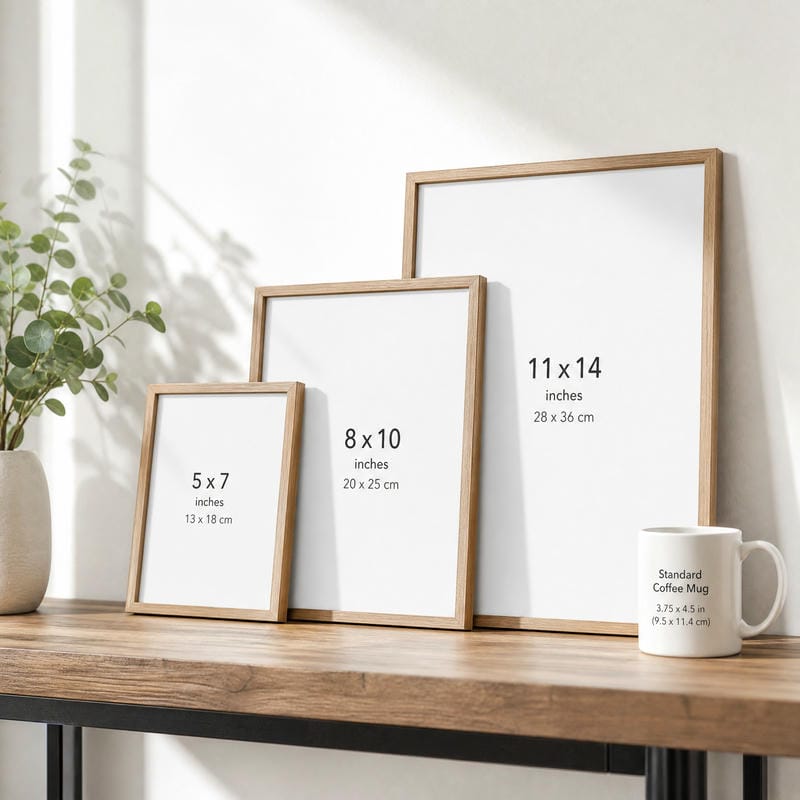
- 5x7 Inches: Think of a standard greeting card. It is intimate and requires getting close to see the details. Best for desk displays or small hallway groupings. If you want to add a mat to a 5x7 photo, you will need an 8x10 frame.
- 8x10 Inches: Slightly smaller than a standard sheet of printer paper. This is the workhorse of the framing world. Watch out for cropping, though. Most smartphone cameras shoot in a 4:3 ratio. Printing those digital files at 8x10 will chop off a noticeable chunk of your original image on the long edges.
- 11x14 Inches: Now we are talking wall art. This size demands attention. It is large enough to anchor a small wall on its own.
If you are unsure how these dimensions will look in your specific room, read our guide on how to measure art for framing before you make a purchase.

The Heavy Reality of Large Frames
When you step up to 16x20 or 24x36 standard picture frame sizes, the physics change entirely. A 24x36 frame with real glass isn't just large; it is heavy. We are talking 10 to 14 pounds depending on the wood density.
I once had a customer try to hang a solid oak 24x36 frame using a single basic thumbtack. It ripped a three-inch gash down their drywall at 2 AM, shattering the glass everywhere. For anything over 11x14, you need proper wall anchors rated for at least 20 pounds. Alternatively, you can switch to acrylic glazing instead of glass to cut the overall weight in half.
This weight factor is a major reason why many people debate between custom vs standard frames for oversized art.
Your Pre-Framing Checklist
Before you hit checkout, run through these physical checks:
- Measure the exact paper size: Do not trust the label on the poster tube. Unroll it and use a metal tape measure. A "24x36" poster is often actually 24.25 x 36.25 inches, which will buckle and wrinkle inside a standard frame.
- Check the depth: Canvas panels need a frame with a "rabbet" (the inner channel) depth of at least 3/4 inch. Standard frames usually only offer 3/8 inch of depth, leaving your canvas sticking out the back.
- Buy the mat first: If you are confused by the math, buy your pre-cut mat, tape your photo to the back of it, and then measure the outside edges of the mat to find your required frame size.

Frequently Asked Questions
What size frame do I need for an 8x10 print with a mat?
You need an 11x14 frame. A standard pre-cut mat for an 11x14 frame has an opening of roughly 7.5 x 9.5 inches. This neatly overlaps the edges of your 8x10 photo to hold it securely in place without falling through the hole.
Does the frame size include the outside border?
No. Frame dimensions always refer to the inside opening where the glass sits. A 16x20 frame holds a 16x20 piece of glass, but the outside dimensions on your wall could be 20x24 if the wooden frame molding is two inches wide.
Why is my 5x7 photo falling out of my 5x7 frame?
You likely bought a "floating" frame designed to sandwich a smaller photo (like a 4x6) between two pieces of glass. For a true 5x7 photo to stay put, you need a traditional frame with a solid backing board. You can read more about industry standards for framing materials to understand the different backing types.
Stop Guessing Your Measurements
You don't have to settle for frames that almost fit or risk damaging your artwork by squeezing it into the wrong size. Find the exact dimensions your walls deserve.
Browse our collection of exact-fit standard picture frames